Now you can get information on new or existing listings faster, smarter and more personalized by receiving info on only what you ask for and accessing it wherever you are with any of our 1st to Know tools: email, text, phone, mobile web, & iPhone. To see a quick video overview, click here.
1st to Know email is a service that searches properties from any company in all our MLSs each day and provides you with e-mail updates if there are any new listngs, open houses, or price reductions meeting your search criteria...making you the 1st to Know. 1st to Know puts you at an advantage in this competitive buyer's market. This information is the most current, complete and accurate since it's never more than 24 hours old and it's letting you know via email right away of any new opportunities. If you are new to 1st to Know email service, CLICK HERE TO REGISTER.
NEW! 1st to Know tools to use when on the road to search and view properties on your MOBILE phone:
1st to Know phone:
Listen to details about any home and receive text messages and pictures on your phone: Dial 800-840-5555 -- Press 1 -- Enter the HOUSE NUMBER (even if listed by another company)
1st to Know text:
Text the word MYINFO to 59559 and get the details on any home of interest sent directly to your phone.
1st to Know mobile web:
Access any of our Web sites from your phone's internet browser where you'll be directed to our mobile friendly site: www.mihome.mobi. You can view property details from the text messages sent from the 1st to Know: text & phone programs by just clicking the link provided in text message.
1st to Know iPhone: To use our property search app designed for your iPhone: Go to iTunes Apps and search for "Real Estate One" to download our app or click here.
If you are already using 1st to Know email and working with one our agents, you can register for 1st to Know text & phone after logging into your account. Registering allows your agent to help you when you have questions about any property you are viewing. If you are not registered for 1st to Know email, CLICK HERE TO REGISTER for all of the 1st to Know tools.

Friday, June 25, 2010


Friday, June 11, 2010
May Market Update
As expected, the Michigan real estate market Market did react to the combined loss of the homebuyer tax credit and end of the Homestead deadline. The good news is the reaction was less than expected. Adjusting for seasonality, the Detroit metro area pending sales fell 30% compared to the feeding frenzy of February - April (which equaled the peak activity levels of 2004/05). We expected closer to a 50% drop. The sales activity was equal to the pace in both May of 09' and 08,' when bank owned properties were fueling the Michigan real estate market. The direction of economic news, even locally, is generally good so Buyers are gaining confidence. This won't be a flood, but if it continues, will be a strong offset for the increase in bank owned homes and potential rise in interest rates that will hit the market later this year and next.
The market has improved at all price points in terms of months supply of For Sale inventory, the most in the under $100,000 market.
Under $100,000: May 08' - 9 months supply vs. 4 months today - 55% improvement $100,000 to $400,000: May 08' - 16 months vs. 7.5 months today - 53% improvement
Over 400,000: May 08' - 24 months vs. 15.5 months today - 35% improvement
In terms of market activity, financial distressed sales still make up nearly 80% of all transactions, it is just that the mix has shifted from mainly bank owned to an even mix of bank, short sales and leases. As banks learn the importance of avoiding foreclosure, Short Sales may move to as high as 50% of all transactions. It is important for Sellers to keep in mind that Traditional Retail properties make up over 50% of all listings, yet 20% of all sales, highlighting the importance of getting your price to a level that will draw attention competing with the financially stressed sales. As a Seller, If your home has been on the market during the past four months and has not received an offer (in the most active time in the past 6 years) then it is pretty clear your price/condition is out of balance.
For homes under $100,000, if priced right, on average, you can expect an offer in less than 60 days at 96% of asking price. Home that don't, are most likely over priced by over 20% and will remain on the market for another 100+ days. For the $100,000-$400,000 market if the home does not sell in 80 days it is on average over priced by 13% and will stay on the market an additional 100 days as well. The $400,000 market on average will take 5 months to sell for 90% of asking price. If it missed that market, then it will likely remain on the market for another 7 months and will be over priced by 27%. The overall conclusion regardless of price range is if a Seller is not getting offers within the "No Price Reduction" market times, a fast price adjustment is in order.

The market has improved at all price points in terms of months supply of For Sale inventory, the most in the under $100,000 market.
Under $100,000: May 08' - 9 months supply vs. 4 months today - 55% improvement $100,000 to $400,000: May 08' - 16 months vs. 7.5 months today - 53% improvement
Over 400,000: May 08' - 24 months vs. 15.5 months today - 35% improvement
In terms of market activity, financial distressed sales still make up nearly 80% of all transactions, it is just that the mix has shifted from mainly bank owned to an even mix of bank, short sales and leases. As banks learn the importance of avoiding foreclosure, Short Sales may move to as high as 50% of all transactions. It is important for Sellers to keep in mind that Traditional Retail properties make up over 50% of all listings, yet 20% of all sales, highlighting the importance of getting your price to a level that will draw attention competing with the financially stressed sales. As a Seller, If your home has been on the market during the past four months and has not received an offer (in the most active time in the past 6 years) then it is pretty clear your price/condition is out of balance.
For homes under $100,000, if priced right, on average, you can expect an offer in less than 60 days at 96% of asking price. Home that don't, are most likely over priced by over 20% and will remain on the market for another 100+ days. For the $100,000-$400,000 market if the home does not sell in 80 days it is on average over priced by 13% and will stay on the market an additional 100 days as well. The $400,000 market on average will take 5 months to sell for 90% of asking price. If it missed that market, then it will likely remain on the market for another 7 months and will be over priced by 27%. The overall conclusion regardless of price range is if a Seller is not getting offers within the "No Price Reduction" market times, a fast price adjustment is in order.

Monday, May 17, 2010
1st To Know - Home Buying Process Goes Mobile!
Home Buying Experience Goes Mobile
Real Estate One Family of Companies Unveils New Mobile Phone Features to Assist Consumers Searching for Available Residential Real Estate Listings
Metro Detroit – Real Estate One, the largest brokerage in Michigan with around 1600 agents and 67 total offices, announced today a new text tool to aid in the consumer’s search for real estate. Real Estate One is the first brokerage in the Motor City that has more data to search than any other broker using any mobile phone.
Consumers will be able to find out useful information on a property, whether it is listed by Real Estate One or another broker/agent. Already in existence is 1st to Know email, a program that automatically sends a client new listings. Now available for consumers is 1st to Know phone, voice, and mobile web that provide information on any property from any company when on the road. The following details explain each new product:
1st to Know phone: Simply dial 800-840-5555 and press 1 to enter a house number. Listen to details of the home and have text messages and pictures sent to your phone upon request. You can request to be connected to the Listing Agent for more information on any property if you have any questions.
1st to Know text: Text the word MYINFO to 59559 to be texted instructions on how to get the details of any home of interest sent directly to your phone.
1st to Know mobile web: With any Smartphone, you can access the full property details for any property requested in 1st to Know phone or 1st to Know text using the link provided in the text message. You can also search all properties available by accessing any of our company Web sites which will direct you to our mobile friendly site, www.mihome.mobi, when accessed from your phone.
Dan Elsea, Real Estate One’s President of Brokerage Services states “As Consumers, we expect services to be faster, smarter and more personal than ever before. Our 1st to Know programs reach all three with easy to use personalized market information anywhere, at any time”.
About Real Estate One
Founded in 1929, Real Estate One is a Michigan based company in their third generation of family ownership. Ranked as the 10th largest broker in the nation by Real Trends, with 67 offices throughout the State as well as operating one of Michigan’s largest Mortgage and Title Insurance companies; providing a single source of services for all their client’s real estate needs. To see more information on the 1st to Know program go to: www.realestateone.com
Real Estate One Family of Companies Unveils New Mobile Phone Features to Assist Consumers Searching for Available Residential Real Estate Listings
Metro Detroit – Real Estate One, the largest brokerage in Michigan with around 1600 agents and 67 total offices, announced today a new text tool to aid in the consumer’s search for real estate. Real Estate One is the first brokerage in the Motor City that has more data to search than any other broker using any mobile phone.
Consumers will be able to find out useful information on a property, whether it is listed by Real Estate One or another broker/agent. Already in existence is 1st to Know email, a program that automatically sends a client new listings. Now available for consumers is 1st to Know phone, voice, and mobile web that provide information on any property from any company when on the road. The following details explain each new product:
1st to Know phone: Simply dial 800-840-5555 and press 1 to enter a house number. Listen to details of the home and have text messages and pictures sent to your phone upon request. You can request to be connected to the Listing Agent for more information on any property if you have any questions.
1st to Know text: Text the word MYINFO to 59559 to be texted instructions on how to get the details of any home of interest sent directly to your phone.
1st to Know mobile web: With any Smartphone, you can access the full property details for any property requested in 1st to Know phone or 1st to Know text using the link provided in the text message. You can also search all properties available by accessing any of our company Web sites which will direct you to our mobile friendly site, www.mihome.mobi, when accessed from your phone.
Dan Elsea, Real Estate One’s President of Brokerage Services states “As Consumers, we expect services to be faster, smarter and more personal than ever before. Our 1st to Know programs reach all three with easy to use personalized market information anywhere, at any time”.
About Real Estate One
Founded in 1929, Real Estate One is a Michigan based company in their third generation of family ownership. Ranked as the 10th largest broker in the nation by Real Trends, with 67 offices throughout the State as well as operating one of Michigan’s largest Mortgage and Title Insurance companies; providing a single source of services for all their client’s real estate needs. To see more information on the 1st to Know program go to: www.realestateone.com
Tuesday, April 27, 2010
Return on Investment
This link is an interesting article about the return you may actualize by making some simple adjustments in your home. Winterization, energy efficient appliances and lighting all play a role in saving you money on energy costs! Please, read on...
Wednesday, April 14, 2010
March Market Update
Business has heated up in the past 45 days. The market activity certainly reflects the tax credit activity.
A view of the Months Supply of Inventory (MSI) for the first quarter of 2010 shows the differences in the pace of sales within pricing segments. MSI represents the number of months it would take to sell the For Sale inventory at the current sales pace. Over 6 months is a Buyers Market, 3-6 months is a Neutral Market and under 3 months is a Sellers Market.
We are seeing the first signs of pricing stability in the under $100,000 market and even in some segments of the under $200,000 market. For our five county market the under $100,000 the MSI is at 3.2 months, a neutral market. For $100-200,000 the MSI is 6.3 months, just above neutral and for over $200,000, 10.4 months, still a strong Buyer's Market.
We are anticipating the year to be a roller-coaster, furious activity the first six months with a slow down the second half. But keep in mind the hot first half is being compared to a really slow 09' and the second half of 10' is being compared to a really strong 09'. So the stats will show a market looking much worse after June than it really is. None the less, it will be slower, since the core economy has not picked up enough to make up for the loss of tax credits and the possibly of rising rates. All that said, the web traffic increases we are seeing show that just as there is a shadow inventory of bank owned homes hanging over the market, there is also a shadow inventory of buyers just waiting for some consistent good economic news to jump into the market.
Click here for the graph that will give you a relative feel for the strength of the market, by showing the seasonally adjusted annualized rate of sales for the five counties. You can see that the annual sales pace has been on the rise since the summer of last year. Most signs are good, however the value appreciation light is still not green, so sellers need to remain aggressive with pricing.

A view of the Months Supply of Inventory (MSI) for the first quarter of 2010 shows the differences in the pace of sales within pricing segments. MSI represents the number of months it would take to sell the For Sale inventory at the current sales pace. Over 6 months is a Buyers Market, 3-6 months is a Neutral Market and under 3 months is a Sellers Market.
We are seeing the first signs of pricing stability in the under $100,000 market and even in some segments of the under $200,000 market. For our five county market the under $100,000 the MSI is at 3.2 months, a neutral market. For $100-200,000 the MSI is 6.3 months, just above neutral and for over $200,000, 10.4 months, still a strong Buyer's Market.
We are anticipating the year to be a roller-coaster, furious activity the first six months with a slow down the second half. But keep in mind the hot first half is being compared to a really slow 09' and the second half of 10' is being compared to a really strong 09'. So the stats will show a market looking much worse after June than it really is. None the less, it will be slower, since the core economy has not picked up enough to make up for the loss of tax credits and the possibly of rising rates. All that said, the web traffic increases we are seeing show that just as there is a shadow inventory of bank owned homes hanging over the market, there is also a shadow inventory of buyers just waiting for some consistent good economic news to jump into the market.
Click here for the graph that will give you a relative feel for the strength of the market, by showing the seasonally adjusted annualized rate of sales for the five counties. You can see that the annual sales pace has been on the rise since the summer of last year. Most signs are good, however the value appreciation light is still not green, so sellers need to remain aggressive with pricing.

Wednesday, April 07, 2010
Tuesday, April 06, 2010
Case-Shiller Report
Here is the latest Case-Shiller Report (January). It shows that the
country is following the same price stabilization trend as the past
eight months. For the first time since mid 2006, across the national
composite, prices did not fall compared to the same month (Jan) of
last year. Although Detroit still showed a decline, the rate of
decline continues to slow. Prices across the country are equivalent to
fall of 2003. For Michigan, prices still fall in the 1996 range. The
good news is we are back to the same "tax frenzy" activity levels we
saw last fall when the first tax credits we expiring - Now is still the time to buy!
country is following the same price stabilization trend as the past
eight months. For the first time since mid 2006, across the national
composite, prices did not fall compared to the same month (Jan) of
last year. Although Detroit still showed a decline, the rate of
decline continues to slow. Prices across the country are equivalent to
fall of 2003. For Michigan, prices still fall in the 1996 range. The
good news is we are back to the same "tax frenzy" activity levels we
saw last fall when the first tax credits we expiring - Now is still the time to buy!
Wednesday, March 10, 2010
February Market Update
February has picked up speed, indicating that the tax credits may be having a more significant impact than we had first projected. I am hearing stories of move-up buyers acting as a direct result of the $6,500 credit, which we had not expected. In addition, with inventories shrinking, we are moving towards a balanced market in some price ranges. Behind that good news there still continues an underlying weakness with inventories still in the Buyer's Market range for most price ranges (Months Supply of Inventory moving from 8 months to 4 months under $100,000 and from 24 to 9 months over $100,000 Feb 09' vs. Feb 08').
We still project a slowing market the second half of this year and it will feel even slower than it really is because of comparisons to a very strong second half of 2009.
A new wild card in the process is the implementation of HAMP (Home Affordable Modification Program - for loan modifications) and HAFA (Home Affordable Foreclosure Alternative Program - for short sales) in April. These two Federal initiatives are designed to reduce the number of foreclosures and stream line the Short Sale process. Their success will depend on the lenders ability to shift, staff up and train to the new program. We expect it to be a slow start, but, if effective, they do offer the opportunity to help offset the effects of the growing "Shadow Inventory" of delinquent, bank inventory and not yet foreclosed properties.
Although the market is by no means robust, this will be the best spring in the past three years for Sellers and in relative terms the best values in years for Buyers. A rare perfect moment for all parties!
Here is our activity for February, generating more buyers and sellers than any other broker in the state.

We still project a slowing market the second half of this year and it will feel even slower than it really is because of comparisons to a very strong second half of 2009.
A new wild card in the process is the implementation of HAMP (Home Affordable Modification Program - for loan modifications) and HAFA (Home Affordable Foreclosure Alternative Program - for short sales) in April. These two Federal initiatives are designed to reduce the number of foreclosures and stream line the Short Sale process. Their success will depend on the lenders ability to shift, staff up and train to the new program. We expect it to be a slow start, but, if effective, they do offer the opportunity to help offset the effects of the growing "Shadow Inventory" of delinquent, bank inventory and not yet foreclosed properties.
Although the market is by no means robust, this will be the best spring in the past three years for Sellers and in relative terms the best values in years for Buyers. A rare perfect moment for all parties!
Here is our activity for February, generating more buyers and sellers than any other broker in the state.

Thursday, February 25, 2010
Real Estate One Market Activity in January
January market activity continued the eight month trend of improving over the prior year (January of 09'). The year started out pretty slow last year so we expected an increase which we got (+25% / 8% volume). It is early, but two trends are apearing: 1) On the positive side, buyer interest (tracked by showing appointments, open house visitors and web activity) remains as strong as in the fall when we had our tax credit induced feeding frenzie and 2) On the concern side, the tax credit impact in the last 60 days has fallen off. We had suspected the majority of first time buyers that were going to act did last year and current activity supports that, but it may be they are just holding off a bit for the spring. The continued strength of buyer interest reenforces our feeling that there is a growing pent up demand that will sustain a steady but slow growth in our market (slow because many of those "lookers" are still being held back by financial issues that, as soon as they see some positive news, will bring them back into the market).
As we have said for the past few months, the first half of 2010 is a strange time where is it will be the best time for both Sellers to sell and Buyers to buy. For Sellers, with inventories and interest rates low, it will be as close (but not quite) to a Seller's market they will see this year. For Buyers, low rates and tax incentives, combined with the expectation of higher rates after mid year, make it a optimum time to buy as well.
As we have said for the past few months, the first half of 2010 is a strange time where is it will be the best time for both Sellers to sell and Buyers to buy. For Sellers, with inventories and interest rates low, it will be as close (but not quite) to a Seller's market they will see this year. For Buyers, low rates and tax incentives, combined with the expectation of higher rates after mid year, make it a optimum time to buy as well.
Friday, January 15, 2010
December Market Update
December sales activity was a good chance to see how the market is settling after the "almost" expiration and then extension of the tax credits. Nationally, December pending sales showed some significant declines as a result of a huge activity bulge in October and November. Locally, our December sales grew over December of 2008, although at a declining rate (10% increase compared to nearly 40% in November vs. November of 08'). You will also notice the number of markets in both the over and under $100,000 markets where the median sale price rose compared to December of 2008. As discussed in prior months, this is due to the shifting of the homes being sold. With fewer bank owned properties on the market, the extreme low end of each price category has dried up, forcing buyers to move up to more expensive homes. There may be some evidence of a form of home value appreciation in the under $100,000 market. It shows up in bank owned properties being put on the market at higher values than they were last year (i.e., banks being less aggressive with low ball pricing because inventories are lower). It can be debated if this is true appreciation, but if not, it certainly is the first move towards appreciation (at least at the lower end of the market).
Here are our numbers for the month and the last quarter, we finished very strong and are carrying some great momentum into 2010!. In terms of closings, we almost beat our November numbers, which would have been the first time in our history! For the full year 2009, it was our second best year in terms of total number of transactions! However, the make up of those transactions was very different from those back in 2005. Financially Stressed transactions (Foreclosed, Short Sale or Leases) still make up 65% of our business, showing that the combination of the lure of great deals and immediate financial needs for many sellers creates activity, even in a recession.
There will certainly be a few bumps as the market unfolds towards the end of the year so take advantage of the good momentum in the first half of '10, whether as a Seller (most buyer activity will be in the first half of 2010, so be aggressive in pricing) or Buyer (low rates, low prices, tax credits) or both.
Here are our numbers for the month and the last quarter, we finished very strong and are carrying some great momentum into 2010!. In terms of closings, we almost beat our November numbers, which would have been the first time in our history! For the full year 2009, it was our second best year in terms of total number of transactions! However, the make up of those transactions was very different from those back in 2005. Financially Stressed transactions (Foreclosed, Short Sale or Leases) still make up 65% of our business, showing that the combination of the lure of great deals and immediate financial needs for many sellers creates activity, even in a recession.
There will certainly be a few bumps as the market unfolds towards the end of the year so take advantage of the good momentum in the first half of '10, whether as a Seller (most buyer activity will be in the first half of 2010, so be aggressive in pricing) or Buyer (low rates, low prices, tax credits) or both.


Data Source: MiRealsource, Realcomp, TAAR, Ann Arbor Board & BrokerMetrics
Ave Chance reflects the % chance the average home will sell in the next 30 days under the current rate of sales
*Includes Eastpointe, Harper Woods and St. Clair Shores
** Includes Grand Traverse, Kalkaska, Antrim, Leelanau and Benzie counties, waterfront properties and vacant land
Ave Chance reflects the % chance the average home will sell in the next 30 days under the current rate of sales
*Includes Eastpointe, Harper Woods and St. Clair Shores
** Includes Grand Traverse, Kalkaska, Antrim, Leelanau and Benzie counties, waterfront properties and vacant land
Thursday, December 17, 2009
The Official Word of How to Figure the Square Footage of Your Home!
The link below will take you to the official guide book on how to figure out square footage in a home. One of our most common legal complaints is the square footage on the MLS and tax records did not match the actual. This is a great reference to have on hand...Enjoy:
American National Standard
American National Standard
Friday, November 13, 2009
What to do about property taxes?
With lower property values due to our struggling economy, many homeowners have been able to take advantage of an exemption contained in the Michigan Transfer Tax Act. If your seller meets the criteria, they would be exempt from paying the state transfer tax. Following are the criteria:
The property must have been occupied as a principle residence – classified as homestead property.
The property’s SEV for the calendar year in which the transfer is made must be less than or equal to the property’s SEV for the calendar year in which the seller acquired the property.
The property cannot be transferred for consideration exceeding its “true cash value” for the year of the transfer.
For example:
If the SEV of the homestead principle residence when acquired in 2005 is $100,000 and the current SEV on the property is $90,000, then the first two criteria have been met. To establish the “true cash value” of the property, you must double the current SEV at the time of transfer. In this scenario, the true cash value would be $180,000. If the property sold for $170,000, then the 3rd criteria has been met of Exemption “u” as designated by the Michigan Transfer Tax Act.
Please call your local Real Estate One Sales Associate if you have more questions or to chat about this topic.
The property must have been occupied as a principle residence – classified as homestead property.
The property’s SEV for the calendar year in which the transfer is made must be less than or equal to the property’s SEV for the calendar year in which the seller acquired the property.
The property cannot be transferred for consideration exceeding its “true cash value” for the year of the transfer.
For example:
If the SEV of the homestead principle residence when acquired in 2005 is $100,000 and the current SEV on the property is $90,000, then the first two criteria have been met. To establish the “true cash value” of the property, you must double the current SEV at the time of transfer. In this scenario, the true cash value would be $180,000. If the property sold for $170,000, then the 3rd criteria has been met of Exemption “u” as designated by the Michigan Transfer Tax Act.
Please call your local Real Estate One Sales Associate if you have more questions or to chat about this topic.
Friday, November 06, 2009
Selling Your Home in a Michigan Winter
Selling a home can be a daunting task in the current market. Now it is even tricker with the onset of winter. While the location of your home is the most important feature to most buyers, it is the one thing that cannot be changed. There are plenty of other factors that you DO have control over that will enhance your ability to sell.
First of all, curb appeal. When a potential buyer pulls up in front of your home what do they see? Rake up the leaves, take out the remnants of last summer's flowers and trim up the perennials. Even though it is the time of year all the vegitaion tends to fade away, a tidy appearance of what remains will be an inviting view from the street. Accentuate your landscape with the use of creative up-lighting. Also pay attention to your entryway. The front door tends to be the focal point of a home. A welcome appearance to your front door will speak volumes to those entering! Make a great first impression.
The first step inside your home needs to have "wow" factor. A clean and fresh entry is a necessity! Organization and proper clutter reduction throughout the home is at the top of the list of things every home seller must do. Remove personal items including family photos, pet beds and children's items. Decorate in neutral colors using mirrors to enhance the sizes of the rooms. Accessorize tastefully, in this case less is always more. You want a potential buyer to be able to visualize their own items in your home but if they are overwhelmed by your belongings they may not be able to imagine anything at all.
Above all else, be realistic. Price, terms and condition are all factors in the home selling equation. To help you determine what those things are, choose a professional REALTOR to assist you. A true professional will know the facts about your local market and can recommend a sound marketing plan to help get you the results you desire. Homes are selling and with the right tools and attitude, you can achieve success.
First of all, curb appeal. When a potential buyer pulls up in front of your home what do they see? Rake up the leaves, take out the remnants of last summer's flowers and trim up the perennials. Even though it is the time of year all the vegitaion tends to fade away, a tidy appearance of what remains will be an inviting view from the street. Accentuate your landscape with the use of creative up-lighting. Also pay attention to your entryway. The front door tends to be the focal point of a home. A welcome appearance to your front door will speak volumes to those entering! Make a great first impression.
The first step inside your home needs to have "wow" factor. A clean and fresh entry is a necessity! Organization and proper clutter reduction throughout the home is at the top of the list of things every home seller must do. Remove personal items including family photos, pet beds and children's items. Decorate in neutral colors using mirrors to enhance the sizes of the rooms. Accessorize tastefully, in this case less is always more. You want a potential buyer to be able to visualize their own items in your home but if they are overwhelmed by your belongings they may not be able to imagine anything at all.
Above all else, be realistic. Price, terms and condition are all factors in the home selling equation. To help you determine what those things are, choose a professional REALTOR to assist you. A true professional will know the facts about your local market and can recommend a sound marketing plan to help get you the results you desire. Homes are selling and with the right tools and attitude, you can achieve success.
Wednesday, October 14, 2009
September Market Update
The big continuing question is: Are the last four months a real bottom and bounce up or just an illusion? The answer is a little of both. There is no question we are at a bottom, the bigger issue is how long will we stay here and is there a chance of a second "dip" down (i.e., a "W" vs. a "V" recovery). The second dip will be largely dependent on to what degree the government extends or adds to the current housing stimulus efforts. A reduction of the stimulus will cause a downward dip.
If there ever was an example of government dollars and intervention at work, the current housing market is it. There are four key government support elements at play and a fourth private sector effort that contribute to the improving housing numbers we are seeing both in Michigan and across the country.
1) The First Time Home Buyer Tax Credit, creating over 400,000 sales out of a national total of 1.4 million (both NAR and Moody's stats)
2) The government's financial support of Fannie Mae, Freddie Mac and the FHA - Contrary to what the average person may think, these are the chief buyers and creators of mortgage products, not banks. FHA mortgages constitute nearly 70% of all John Adams mortgages.
3) Low interest rates, created by a near zero % federal funds rate and the government's purchase of most of the mortgages being made (since other financial institutions don't want to buy them, without the government purchase, rates would have to rise to entice others to buy).
4) The banks current direction, with both a stick and carrot from the government, of a slower release of foreclosed inventories into the market, helping to stabilize home values.
Keep in mind these improving numbers have not yet moved up enough into the middle to upper range home values. That will not really take hold until employment stabilizes, giving two income families (one of the core engines to move up buyer growth) the confidence to sell and buy and the mass of former owners, now renters, the ability to become home owners again.
In Michigan, the overall market in the next 12 months is most likely to be either the same (extended stimulus) or down (not extended), so regardless of the outcome of the stimulus programs, Sellers still need to price aggressively, focusing as much on current competition as comparable sales. Buyers should be aware that an extended stimulus will benefit them but it will, combined with the banks holding back their inventories, also help dry of the current supply, making the best buys more scarce.
As a company, beginning in June, each month has been successively better for us, extremely hectic, but better. The sales are unprecedented in their complexity and in many cases, anxiety. Collectively, each of us, our clients, mortgage, title and staff feel like we are walking up a sand dune, three steps forward and two back. But we are making great progress and in that effort helping people that have never in the past 70 years needed us more.
Here are our numbers for the month, as usual, better than anyone else. Also two very important bragging points, our Traverse City offices were named the Hottest Real Estate Company buy the TC Record Eagle and John Adams is now the number one FHA lender in purchase mortgages in Southeast Michigan!
If there ever was an example of government dollars and intervention at work, the current housing market is it. There are four key government support elements at play and a fourth private sector effort that contribute to the improving housing numbers we are seeing both in Michigan and across the country.
1) The First Time Home Buyer Tax Credit, creating over 400,000 sales out of a national total of 1.4 million (both NAR and Moody's stats)
2) The government's financial support of Fannie Mae, Freddie Mac and the FHA - Contrary to what the average person may think, these are the chief buyers and creators of mortgage products, not banks. FHA mortgages constitute nearly 70% of all John Adams mortgages.
3) Low interest rates, created by a near zero % federal funds rate and the government's purchase of most of the mortgages being made (since other financial institutions don't want to buy them, without the government purchase, rates would have to rise to entice others to buy).
4) The banks current direction, with both a stick and carrot from the government, of a slower release of foreclosed inventories into the market, helping to stabilize home values.
Keep in mind these improving numbers have not yet moved up enough into the middle to upper range home values. That will not really take hold until employment stabilizes, giving two income families (one of the core engines to move up buyer growth) the confidence to sell and buy and the mass of former owners, now renters, the ability to become home owners again.
In Michigan, the overall market in the next 12 months is most likely to be either the same (extended stimulus) or down (not extended), so regardless of the outcome of the stimulus programs, Sellers still need to price aggressively, focusing as much on current competition as comparable sales. Buyers should be aware that an extended stimulus will benefit them but it will, combined with the banks holding back their inventories, also help dry of the current supply, making the best buys more scarce.
As a company, beginning in June, each month has been successively better for us, extremely hectic, but better. The sales are unprecedented in their complexity and in many cases, anxiety. Collectively, each of us, our clients, mortgage, title and staff feel like we are walking up a sand dune, three steps forward and two back. But we are making great progress and in that effort helping people that have never in the past 70 years needed us more.
Here are our numbers for the month, as usual, better than anyone else. Also two very important bragging points, our Traverse City offices were named the Hottest Real Estate Company buy the TC Record Eagle and John Adams is now the number one FHA lender in purchase mortgages in Southeast Michigan!

Thursday, October 01, 2009
FAQ about Foreclosures and HUD Homes
As the fall sets in and the year comes to a close, the First Time Homebuyer Tax Credit is also winding down. To take advantage of the credit you must get your home under contract within the next few weeks. Many buyers are finding themselves in a position where a foreclosure is the home of choice, even if that was not the original intention. Here are some frequently asked questions and answers about foreclosures that may be helpful in this crunch-time...
Q: What does "REO" mean?
A: Real Estate Owned. It's the term the banks use to identify their foreclosure properties. These properties are also considered distressed properties.
Q: How is a HUD property different from any other foreclosure?
A: HUD homes are FHA-insured loan foreclosures. The government owns them. The properties are classified as "insured" or "uninsured". Those that are insured are in good repair and FHA will insure a new loan for a new buyer for the home. Uninsured properties are typically fixer-uppers, and the buyer will be responsible for his or her own financing. Find out more on their website at www.hud.gov.
Q: What are some general guidelines for your market?
A: Many of the properties that are listed require an earnest money deposit of $1000 and are sold "as is". Many REO properties will sell for cash or with a variety of financing including FHA, VA, and conventional financing. One should remember that many times an REO property will be in a somewhat distressed condition.
Q: How are foreclosure properties identified on the MLS?
A: Certain MLS systems have a selection box on their profile form for bank-owned property and others do not. They are listed just like any other property. The best way to find them is by working with a real estate broker who specializes in this kind of home, or by searching the web. Search available listings through www.ourforeclosurehomes.com.
Q: How will the bank determine the selling price? Will banks accept less?
A: When negotiating with asset managers at a bank for the purchase of a foreclosure, they are considered professional sellers. An asset manager will work hard before a property is ever listed to determine fair market value. They order appraisals and hire a broker to advise them about the property's condition and value. Then, they price them accordingly and may or may not accept less.
Q: Will the banks repair the properties that are distressed?
A: Sometimes. The asset manager in charge of the property will confer with his broker prior to listing it to determine if it is a good candidate for repair or rehab. He will then proceed with a marketing strategy - either "as-is" or "repaired". The as-is properties are priced much lower, and the bank typically does not make repairs for these. They feel any repairs should be the responsibility of the buyer since the property's price is already discounted.
If you have any further question, please contact us and we will gladly assist you.
Q: What does "REO" mean?
A: Real Estate Owned. It's the term the banks use to identify their foreclosure properties. These properties are also considered distressed properties.
Q: How is a HUD property different from any other foreclosure?
A: HUD homes are FHA-insured loan foreclosures. The government owns them. The properties are classified as "insured" or "uninsured". Those that are insured are in good repair and FHA will insure a new loan for a new buyer for the home. Uninsured properties are typically fixer-uppers, and the buyer will be responsible for his or her own financing. Find out more on their website at www.hud.gov.
Q: What are some general guidelines for your market?
A: Many of the properties that are listed require an earnest money deposit of $1000 and are sold "as is". Many REO properties will sell for cash or with a variety of financing including FHA, VA, and conventional financing. One should remember that many times an REO property will be in a somewhat distressed condition.
Q: How are foreclosure properties identified on the MLS?
A: Certain MLS systems have a selection box on their profile form for bank-owned property and others do not. They are listed just like any other property. The best way to find them is by working with a real estate broker who specializes in this kind of home, or by searching the web. Search available listings through www.ourforeclosurehomes.com.
Q: How will the bank determine the selling price? Will banks accept less?
A: When negotiating with asset managers at a bank for the purchase of a foreclosure, they are considered professional sellers. An asset manager will work hard before a property is ever listed to determine fair market value. They order appraisals and hire a broker to advise them about the property's condition and value. Then, they price them accordingly and may or may not accept less.
Q: Will the banks repair the properties that are distressed?
A: Sometimes. The asset manager in charge of the property will confer with his broker prior to listing it to determine if it is a good candidate for repair or rehab. He will then proceed with a marketing strategy - either "as-is" or "repaired". The as-is properties are priced much lower, and the bank typically does not make repairs for these. They feel any repairs should be the responsibility of the buyer since the property's price is already discounted.
If you have any further question, please contact us and we will gladly assist you.
Tuesday, August 25, 2009
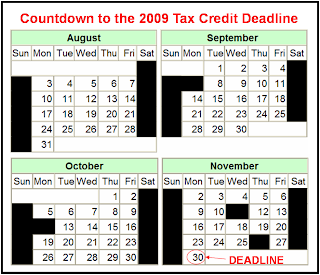
The Time is Now! The 2009 Tax Credit is Winding Down. Don't Miss Out On Your $8,000!
If you are a first time home buyer seeking to take advantage of the possible $8,000 Tax Credit, you may want to get serious. It is officially time to make your move. The closing deadline is November 30, 2009. As of the time of this writing (Aug. 25) you have only 65 business days to close your purchase.
Let's take a look at a practical time line from house hunting to final signatures at the closing table...
Day 1 - 10 - Tour homes and find your dream home then write up an offer.
Day 10 - 17 - Negotiate and get final acceptance signatures.
Day 17 - 30 - Conduct inspections, formally apply for your mortgage, obtain an appraisal and make any necessary repairs.
Day 30 - 40 - Re-inspections and underwriter approvals. Obtain clear to close from all parties.
Day 40 - 45 - Do your final walk-thru and close.
The above is an "ideal" situation with an average time frame. The selling or buying of a home is not always ideal. All too often appraisals take longer than expected, an inspection turns up an unknown issue that must be dealt with prior to closing or funds get delayed the day of closing. Be prepared for these kinds of bumps in the road along the way.
Additionally, there are 4 National Holidays between now and November 30! That's right, we have Labor Day, Columbus Day, Veteran's Day and Thanksgiving to look forward to. You may want to consider this in your personal time frame to be safe. A proactive plan is necessary at this point. Also take into consideration that Wednesday, November 25th could be a 1/2 day for Banks and Title Companies, Thursday is Thanksgiving, Friday is an unofficial holiday making closings unreliable and Monday the 30th is the deadline which makes closing on that day a dangerous gamble. So, if you must wait until November to close - make it early in the month, you'll be glad you did!
Let's take a look at a practical time line from house hunting to final signatures at the closing table...
Day 1 - 10 - Tour homes and find your dream home then write up an offer.
Day 10 - 17 - Negotiate and get final acceptance signatures.
Day 17 - 30 - Conduct inspections, formally apply for your mortgage, obtain an appraisal and make any necessary repairs.
Day 30 - 40 - Re-inspections and underwriter approvals. Obtain clear to close from all parties.
Day 40 - 45 - Do your final walk-thru and close.
The above is an "ideal" situation with an average time frame. The selling or buying of a home is not always ideal. All too often appraisals take longer than expected, an inspection turns up an unknown issue that must be dealt with prior to closing or funds get delayed the day of closing. Be prepared for these kinds of bumps in the road along the way.
Additionally, there are 4 National Holidays between now and November 30! That's right, we have Labor Day, Columbus Day, Veteran's Day and Thanksgiving to look forward to. You may want to consider this in your personal time frame to be safe. A proactive plan is necessary at this point. Also take into consideration that Wednesday, November 25th could be a 1/2 day for Banks and Title Companies, Thursday is Thanksgiving, Friday is an unofficial holiday making closings unreliable and Monday the 30th is the deadline which makes closing on that day a dangerous gamble. So, if you must wait until November to close - make it early in the month, you'll be glad you did!
Monday, August 10, 2009
Pending Home Sales on the Rise Again!
Pending home sales are up for the fifth month in a row, nationally. This information is courtesy of a News Release by the National Association of REALTORS(R) on August 4. This statement is a result of the analysis of pending sales in June 2009 vs. June 2008. During this time period, the number of purchase agreements signed is up by 6.7%. This increase is again attributed to the $8,000 tax credit available to first time home buyers and to the availability of affordable housing.
To read the entire report please click here.
On a more local note, the under $100,000 market is selling strong in the Oakland, Macomb, Livingston, Washtenaw and parts of Wayne Counties (minus the City of Detroit and Gross Pointe areas). The median sales price in these areas (with the exception of Oakland county) continues to plummet, enabling the sell-off of these homes. This sector of the market continues to dominate the closed sales transactions with huge increases over this time last year. These same areas in the over $100,000 market are showing a decrease in the number of closed transactions over last July. Conversely, across the board there is a decrease in the number of homes for sale. The age old theory of supply and demand plays a major part in this market, these trends mark a small step in the direction of recovery.
To view the latest stats please click here.
To read the entire report please click here.
On a more local note, the under $100,000 market is selling strong in the Oakland, Macomb, Livingston, Washtenaw and parts of Wayne Counties (minus the City of Detroit and Gross Pointe areas). The median sales price in these areas (with the exception of Oakland county) continues to plummet, enabling the sell-off of these homes. This sector of the market continues to dominate the closed sales transactions with huge increases over this time last year. These same areas in the over $100,000 market are showing a decrease in the number of closed transactions over last July. Conversely, across the board there is a decrease in the number of homes for sale. The age old theory of supply and demand plays a major part in this market, these trends mark a small step in the direction of recovery.
To view the latest stats please click here.
Monday, July 27, 2009
June Market Recap
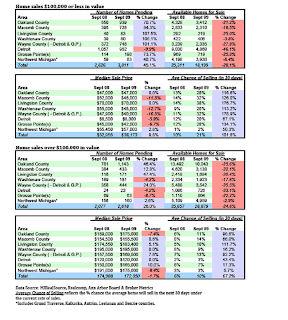
The state of Michigan has been weathering the real estate storm for quite some time now. For those of us who are watching it all play out, you may enjoy the positive news coming from the June 2009 statistics. For the under $100,000 market, Livingston County has exploded with activity showing a 176% increase in homes sold over the same period of 2008. The number of available homes is up by 5.3% in that same area for the same time period and price range while the median sale price has slipped by just under 5%. While not all areas have numbers as impressive as this, the tables below illustrate the activity and changes in the surrounding areas. Click the table to enlarge.
 Will the rally continue? Will the upper-end price ranges see an increase? Only time will tell. Check back for July numbers in a few weeks…
->Data Sources: MiRealSource, Realcomp, Ann Arbor Area Board of REALTORS MLS, Paragon and Broker Metrics.
*Includes Grand Traverse, Kalkaska, Antrim, Leelanau and Benzie Counties, waterfront and vacant land.
 Will the rally continue? Will the upper-end price ranges see an increase? Only time will tell. Check back for July numbers in a few weeks…
->Data Sources: MiRealSource, Realcomp, Ann Arbor Area Board of REALTORS MLS, Paragon and Broker Metrics.
*Includes Grand Traverse, Kalkaska, Antrim, Leelanau and Benzie Counties, waterfront and vacant land.
Monday, July 06, 2009
Good News in Pending Sales; Concerns for Appraisals
For the 4th month in a row, May pending home sales were up. This continued rally is attributed to the combination of the first time home buyer's tax credit and the availability of affordable homes. The Midwest in particular experienced an increase of 11.4% over May 2008. This news is compliments of a Press Release by the National Association of REALTORS published July 1, 2009.
While this is a step in the right direction; there is concern over the number of pending homes that will result in a closing. The new appraisal rules could complicate or prohibit some of these sales from going to closing. As a home seller, it is recommended for you to obtain a current appraisal at the time of listing your home. While this appraisal is for your information only, it will give you a concrete answer to how your home will be evaluated by a professional, unbiased appraiser. As the issue of Short Sales and Foreclosed properties being used for comparison purposes continues to be a problem for traditional sellers, be sure the appraiser used is familiar with your area and uses the best comps available. Choosing an educated and resourceful lender may assist in facilitating a successful sale as well.
Overall, the number of homes for sale continues to be less than in the recent past with the market as a whole continuing to follow buyer's market trends. These along with low interest rates makes now a great time to buy or sell a home.
While this is a step in the right direction; there is concern over the number of pending homes that will result in a closing. The new appraisal rules could complicate or prohibit some of these sales from going to closing. As a home seller, it is recommended for you to obtain a current appraisal at the time of listing your home. While this appraisal is for your information only, it will give you a concrete answer to how your home will be evaluated by a professional, unbiased appraiser. As the issue of Short Sales and Foreclosed properties being used for comparison purposes continues to be a problem for traditional sellers, be sure the appraiser used is familiar with your area and uses the best comps available. Choosing an educated and resourceful lender may assist in facilitating a successful sale as well.
Overall, the number of homes for sale continues to be less than in the recent past with the market as a whole continuing to follow buyer's market trends. These along with low interest rates makes now a great time to buy or sell a home.
Wednesday, June 17, 2009
May Market Update
May continued the same core trends as the prior six months with increasing sales and falling inventories for under $100,000 and the opposite for the above $100,000. There were some signs of the GM and Chrysler effect. The pace of showings and units sales did slow, but the first week of June showed a quick rebound in both again showing the surprising resilience of our market. Our percentage of bank owned and lease sales declined as well in May, reflecting the reduction of bank owned listings in the market. All indications are that it is a temporary shift as banks continue to work through their loan modification efforts to reduce their foreclosures loads. Michigan’s new law allowing homeowners an additional 90 days to negotiate a loan restructure will go into effect August 1st, which will help to reduce and spread out the foreclosure inventory even more.
Great news thanks to the efforts of the Michigan Home Builders Association. HUD has finally issued a Mortgagee Letter that states that condo project approval in no longer required for Site Condos. Also, this month we will be rolling out our Home Mortgage Protection Program that provides mortgage payment protection should a buyer lose their job, similar to what many auto companies are offering. It is offered through John Adams and you will be getting the details next week.
We know that our web site draws the most Michigan traffic, but did you know that our listings are also on 7 of the top 9 national real estate listings web sites (the last two are not yet able to take our listings), covering nearly 40% of all real estate web visitors from those sites alone (Hitwise May reports). We also distribute to 30 (and growing) other sites, focusing on a variety of niches to provide the broadest web exposure of any broker in Michigan.
All lenders and appraisers are under new federal guidelines, making it more difficult to address low or incorrect appraisals. More than ever it is less what the Buyer or Seller think, but what the appraiser thinks for value. In many cases it may be wise for our Sellers to consider appraisals when the home is first put on the market to get an up front feel for any value issues.
For Fence Sitting Buyers who recall high school algebra formulas, this is an important one to keep in mind: Tax Credits + rising interest rates > falling prices. In other words, the value gain receive by taking advantage of both the expiring Tax Credits and low interest rates will exceed any gain from waiting for prices to fall.
Here are our numbers for May as well as the market overview for May and an additional trend analysis for the past 9 months.
Great news thanks to the efforts of the Michigan Home Builders Association. HUD has finally issued a Mortgagee Letter that states that condo project approval in no longer required for Site Condos. Also, this month we will be rolling out our Home Mortgage Protection Program that provides mortgage payment protection should a buyer lose their job, similar to what many auto companies are offering. It is offered through John Adams and you will be getting the details next week.
We know that our web site draws the most Michigan traffic, but did you know that our listings are also on 7 of the top 9 national real estate listings web sites (the last two are not yet able to take our listings), covering nearly 40% of all real estate web visitors from those sites alone (Hitwise May reports). We also distribute to 30 (and growing) other sites, focusing on a variety of niches to provide the broadest web exposure of any broker in Michigan.
All lenders and appraisers are under new federal guidelines, making it more difficult to address low or incorrect appraisals. More than ever it is less what the Buyer or Seller think, but what the appraiser thinks for value. In many cases it may be wise for our Sellers to consider appraisals when the home is first put on the market to get an up front feel for any value issues.
For Fence Sitting Buyers who recall high school algebra formulas, this is an important one to keep in mind: Tax Credits + rising interest rates > falling prices. In other words, the value gain receive by taking advantage of both the expiring Tax Credits and low interest rates will exceed any gain from waiting for prices to fall.
Here are our numbers for May as well as the market overview for May and an additional trend analysis for the past 9 months.
Subscribe to:
Posts (Atom)